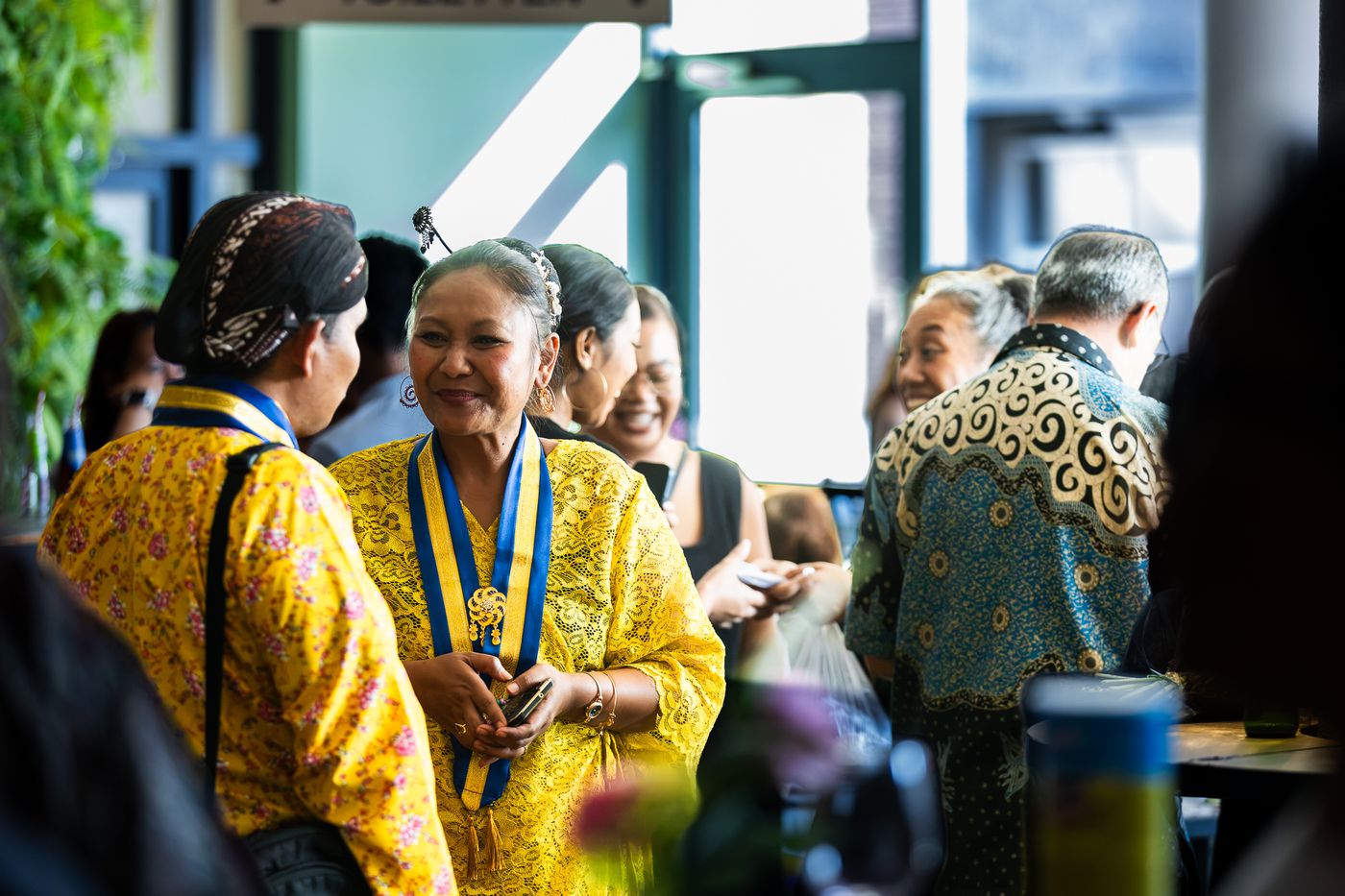
In Andhe Andhe Lumut, culture, personal growth, and intergenerational connection came together. For its creator, the production meant much more than simply bringing a performance to the stage: it became a journey of exploring their Surinamese-Javanese roots and reflecting on the meaning of cultural heritage in the present day. The collaboration with participants, as well as Javanese friends and mentors from Indonesia, showed that culture is not only preserved through stories and archives, but above all remains alive by experiencing it together and passing it on.
When you look back at Andhe Andhe Lumut, what is the first thing that comes to mind?
The first word that comes to mind is growth. Of course, I am incredibly proud of what we eventually brought to the stage, but when you ask me what Andhe Andhe Lumut means to me personally, the performance itself is not actually the first thing I think about. I think about everything that happened before it. The people, the rehearsals, the conversations, the challenges, the confrontations, and also my own development throughout the process. So much happened along the way that the audience never got to see. Looking back, I realize that we weren't simply creating a performance. In our own individual ways, every one of us was going through a process of growth.
Was your personal exploration of your Javanese roots part of that journey as well?
Absolutely. I am Surinamese-Javanese. My ancestors came from Java to Suriname, and eventually my own life journey brought me to the Netherlands. In a way, that means I carry several worlds within me. I was shaped by Suriname, an important part of my roots lies in Java, and my life today is rooted in the Netherlands. For a long time, I simply saw those different worlds as parts of my background. But as I grew older, I began looking at them much more consciously. What does it actually mean to have Javanese roots? Which values did my ancestors carry with them? What was preserved along the way? What changed? And what might we have lost?
At some point, simply knowing where my family came from was no longer enough for me. I wanted to understand it, and even more importantly, I wanted to experience it. Not because I was searching for an identity I didn't have, but because I became curious about the different layers of the identity that had always been there. Andhe Andhe Lumut opened another door in that journey.
Do you think people with a colonial or migration background will recognize themselves in that?
I think many will. A lot of us inherited parts of our culture very naturally through our parents and grandparents: food, music, certain words, customs, humor, ways of interacting with one another, and family stories. At the same time, there can also be gaps. Things that were never spoken about, a language that was gradually spoken less and less, or traditions whose outward form we still recognize without necessarily understanding why they exist.
There can be grief or anger around that, and there absolutely needs to be room for those emotions. We don't need to make our history more beautiful than it was. But personally, my journey did not begin with anger. I don't want loss to be the only lens through which I look at my heritage. Because our history also tells an extraordinary story of resilience. Our ancestors arrived in another part of the world under extremely difficult circumstances, and yet they carried their language, music, food, values, customs, and stories with them. They built communities again. I find that incredibly powerful.
What did Andhe Andhe Lumut represent for you within that journey?
For me, this production existed right at the intersection of past, present, and future. We took a Javanese story and brought it to life again in the Netherlands with people who all have their own relationship with the culture. Some participants are very closely connected to their Javanese roots, others are still exploring them, and some came into the project from completely different backgrounds. Yet we were able to carry the same story together.
It reminded me that cultural heritage is not static. Of course, culture can be documented in books, archives, photographs, and videos, and that is incredibly important. But ultimately, culture stays alive because people practice it, experience it, and pass it on. From person to person, from body to body, from voice to voice, and from generation to generation. During Andhe Andhe Lumut, I watched that happen right in front of me.
You've said before that the rehearsals became about much more than simply rehearsing. What do you mean by that?
When you work intensively with a group of people over a longer period of time, much more begins to surface than talent or technique. Everyone brings themselves into the rehearsal room: their strengths, but also their insecurities, expectations, beliefs, and triggers. That was true for the participants, and it was equally true for me.
There were moments of connection and joy, but also moments of frustration, misunderstanding, or uncertainty. Sometimes someone was affected by a correction. Sometimes something happened between participants. Sometimes something organizational didn't go as expected. And each time, you have a choice: you can focus only on the situation or the other person, or you can also ask yourself, Why is this affecting me? What is happening inside me right now? What can I learn from this?
That may actually be one of the most beautiful things that happened during the process. At times, the rehearsal room literally became a mirror. Not because we were conducting therapy sessions there, but because working closely with other people naturally reveals where you are within yourself.
And what did you see when you looked into that mirror?
Quite a lot, haha. I encountered my own perfectionism, for example, and my enormous sense of responsibility. When I give my heart to something, I want it to be done well. That is one of my strengths, but that same strength can become a limitation when you begin to believe that you have to carry everything yourself.
Throughout this project, I asked myself many times: Am I doing this right? Am I able to bring everyone along? Am I communicating clearly enough? Am I giving people enough space? When do I need to hold on, and when do I need to let go? Those aren't comfortable questions when you're in the middle of a production with dozens of things happening at once. But because of that, I learned a great deal about myself.
Did that change the way you look at leadership?
Definitely. Leadership, to me, is becoming less and less about the person at the front having all the answers. I now believe that real leadership requires you to keep examining yourself. You have to be able to provide direction and make decisions, but you also need to be able to acknowledge when you don't know something or when something happening around you affects you personally.
I also learned that you are not responsible for everybody else's process. You can create space, provide the right conditions, listen, and offer guidance, but ultimately each person has to carry their own part. That realization changed the way I see my role. I don't have to rescue everyone or solve everything. Sometimes my responsibility is simply to remain present, even when things become uncomfortable.
What role did your friends and teachers from Indonesia play in this process?
A very special one. Mbak Wati, Mas Damar, Mbak Bening, and Mas Surono weren't people I went searching for specifically for this project. They were already part of my circle of friends. I knew them and knew what they carried, both as human beings and through their artistry and expertise. When Andhe Andhe Lumut began to take shape, I approached them and asked whether they would be willing to take this journey with us.
What I found particularly meaningful was that the transfer of knowledge didn't happen only through someone explaining how a movement should be performed or how a piece of music should be played. Real knowledge transmission also happens simply by being together. Through observing, being corrected, having conversations, laughing together, and sometimes repeating something over and over again. Because there was already a foundation of friendship and trust, that collaboration carried an additional layer of meaning for me.
Were there particular Javanese values that gained a deeper meaning for you during the process?
Yes. During the process, principles such as sawiji, greget, sengguh, and ora mingkuh came forward. What touched me was that I gradually stopped seeing them solely as principles connected to performing arts. They almost became lessons for life.
For me, sawiji is about being truly present and giving your full attention to what you are doing. Greget is about the inner energy and passion you bring to something. Sengguh is about knowing who you are and trusting your abilities without placing yourself above someone else. And ora mingkuh is about not walking away when things become difficult. That last one, in particular, gained meaning several times during this production. A dream is beautiful when it still exists in your imagination. The moment you begin turning it into reality, challenges inevitably appear. And then the question becomes: Will you stay?
You often use the word “homecoming.” What does homecoming mean to you now?
I think my definition of homecoming has changed. In the past, I may have connected roots more easily to geographical places: Java, Suriname, the Netherlands. Now I increasingly understand that coming home doesn't necessarily mean having to return somewhere.
I don't have to choose which part of my history is the most “authentic.” Java is part of my roots. Suriname is part of my story. The Netherlands is part of my life. Everything that happened along the way has contributed to who I am today. I don't have to remove any part of myself in order to move closer to my origins.
Perhaps that is an important realization for people who grew up between different cultures. You don't have to divide yourself into pieces in order to belong somewhere. All those layers are allowed to coexist. You are allowed to discover for yourself how you want to connect them.
From that perspective, how do you look at your family's colonial history?
I absolutely don't want to deny or romanticize that history. Things happened that had profound consequences, some of which can still be felt generations later. We need to be able to speak about that honestly.
But I also don't want victimhood to become the final chapter of the story. When I look at my ancestors, I don't only see what happened to them. I also see what they did afterwards. They lived. They loved. They raised families. They built communities. They preserved and passed on parts of their culture under circumstances that are difficult for me to even imagine.
There is tremendous strength in that. I cannot change the past, but I do have influence over what I choose to do with that inheritance today. Which stories do I pass on? Which knowledge do I reclaim? Which patterns are allowed to end with us? And which beautiful things do I consciously choose to preserve?
For me, that is an important part of resilience: remembering where you come from without allowing yourself to remain imprisoned by what happened in the past.
What do you hope to pass on to the next generation?
I want our children to be able to do more than simply explain where their ancestors came from. I want them to feel something when they hear gamelan, when they recognize a Javanese word, hear a story, or encounter certain values. They don't have to experience culture exactly the way my generation or previous generations did. In fact, that would be impossible. Every generation gives culture new meaning.
What I hope to pass on is curiosity. I want them to dare to ask questions. I don't want them to feel ashamed when there is something they don't know. I want them to see their roots not as an exam where they have to prove that they are “Javanese enough,” but as a source they are allowed to draw from. Culture should not become a gate where someone decides who is allowed in and who isn't. It can also be a doorway to connection, awareness, and understanding.
And then the day of the performance finally arrived. What happened inside you when you saw what you had all created together?
It was difficult to capture in a single emotion. Of course I felt proud and relieved, but more than anything, I looked at the people. I saw participants who had grown throughout the process. I saw different generations sharing one stage. I saw our friends from Indonesia standing alongside people from the Netherlands. I saw children becoming part of a story that is many generations older than they are.
And I felt very strongly: This is why we do this. Not only for one performance, and not only for the applause. We are creating memories. Perhaps there was a child in the audience who, twenty years from now, will still remember how it felt to hear gamelan for the first time. Perhaps someone left the theatre wanting to learn more about their family history. Perhaps a conversation will begin between a grandparent and a grandchild that otherwise might never have taken place. To me, that is where the real impact lies.
And what happened when it was all over?
Then came the silence. That may have been one of the most vulnerable moments of the entire journey. For months, you live towards one particular moment. Andhe Andhe Lumut is in your mind almost every day, and suddenly it is over. When our friends from Indonesia returned home, I genuinely felt an emptiness. I missed being together, the energy, the conversations, and even some of the hectic moments that, while we were in the middle of them, I probably wished would just be over.
I didn't immediately try to get rid of that emptiness. I allowed it to be there. Because when something truly touches you, it leaves something behind when it ends. That doesn't mean you have to remain stuck in that feeling. It simply means that what you experienced mattered.
If you had to summarize your entire journey in one insight, what would it be?
I would say that Andhe Andhe Lumut taught me that coming home is not the same as going back.
My journey isn't about returning to the past and trying to become who my ancestors once were. I cannot live their lives, and I don't need to.
My responsibility lies in the present.
I can receive what they passed down to me, explore what may have been lost or transformed along the way, and then consciously decide what I want to carry forward.
Java is part of my roots. Suriname is part of my story. The Netherlands is part of my life. And I am the living continuation of all of it.
Perhaps that is ultimately what Andhe Andhe Lumut has meant to me personally: I no longer have to try to bring my different worlds together as though they were ever truly separate.
They already live within me.
And from that place, I want to continue building. Not from the pain of what was lost, but from love for what is still alive and from a sense of responsibility for what we leave to those who come after us."